Boiler trouble, one phone call
HVAC Rescue Pros is a call-connection service, not a contractor. Call (813) 471-5413 and you are connected with an independent local heating company that serves your ZIP code. The call costs you nothing, and the pro you speak with agrees pricing and scheduling with you directly.
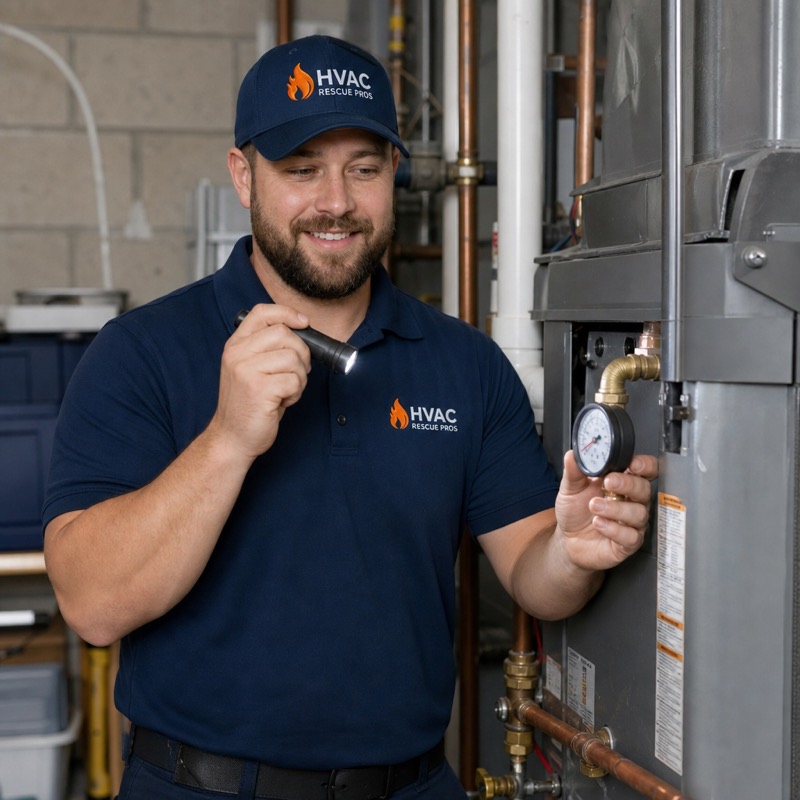
It helps to know which system you have. A hot water boiler pumps water through radiators, baseboard heaters or floor tubing and has a pressure gauge. A steam boiler sends steam up to the radiators and has a glass tube showing the water level.
Signs your boiler needs repair
- Some or all radiators stay cold
- The pressure gauge reads well above or below normal
- Water dripping from the relief valve or its pipe
- Gurgling, banging or a rumbling "kettle" sound
- Water on the floor around the boiler
- The boiler won't fire, the pilot is out or a code is showing
Boiler symptoms at a glance
| Symptom | Common causes | What you can safely check |
|---|---|---|
| No heat anywhere | No power, thermostat, ignition or pilot failure, low pressure, failed circulator pump | Thermostat setting and batteries, breaker, boiler switch, pressure gauge |
| Some radiators cold, others hot | Air in the system, stuck zone valve, closed radiator valve | Radiator valves open; bleed hot water radiators (see below) |
| Upper floors cold | Low pressure, air in the system | Pressure gauge reading |
| Relief valve dripping | Waterlogged expansion tank, fill valve letting in too much water, worn valve | Gauge reading; put a bucket under it |
| Pressure keeps dropping | A leak somewhere, recent bleeding | Look for drips at radiators, pipes and the boiler |
| Rumbling or kettle noise | Scale or sludge in the heat exchanger, poor water flow | Note when it happens and call |
| Banging pipes (steam) | Water trapped in pipes, half-open radiator valve, water level too high | Radiator valves fully open or fully closed |
Reading the pressure gauge (hot water systems)
Read the gauge when the boiler has been off for a while and the water is cool. Many gauges show temperature too.
- Cold system: typically about 12 to 15 psi in a two-story home, enough to push water to the upper-floor radiators.
- Running hot: a rise of a few psi is normal as the water expands.
- Too low: upper radiators go cold and the boiler may shut down. Water is leaving the system somewhere, or air was bled without refilling.
- Too high: close to 30 psi when hot usually points to a waterlogged expansion tank or a fill valve letting in too much water.
Relief valve dripping? This safety valve opens when pressure reaches its set point, typically 30 psi on homes. A drip means pressure is too high or the valve is worn. Put a bucket under it and call. Never cap, plug or tie it shut.
Air in the system and bleeding radiators
Air blocks hot water. Typical signs are radiators cold in the upper part and warm lower down, plus gurgling. On hot water radiators with a small bleed valve, you can let the air out yourself, with care:
- Turn the heat down and let radiators cool. Bleed water can be scalding.
- Hold a cup and rag under the valve and open it about a quarter turn with a radiator key.
- Close it as soon as air stops hissing and a steady stream of water appears.
- Do one radiator at a time, ending with those on the upper floors.
- Check the gauge. If pressure fell below normal, water needs to be added at the fill valve. Ask a pro to do it or show you how.
Baseboard loops usually have no bleed valve and are purged at the boiler by a pro. Steam radiators are never bled: their air vents work on their own.
Parts that commonly fail
Circulator pump
The pump that moves hot water to the radiators. When it fails, the boiler gets hot but the house stays cold. A pump that hums without moving water, often after sitting all summer, needs a pro.
Expansion tank
Water expands as it heats, and this tank absorbs the extra with a cushion of air. Once it fills with water, pressure spikes every time the boiler fires and the relief valve drips.
Zone valves
Homes with several thermostats often have one motorized valve per zone. A valve stuck closed leaves that zone cold. Stuck open, the zone overheats. The motor head often fails first.
Ignition and pilot
Older boilers have a standing pilot and thermocouple. Newer ones use electronic ignition, a flame sensor and error codes. High-efficiency boilers also have a condensate drain that can clog.
Kettling is a rumble like a kettle about to boil. Scale or sludge lets water flash to steam in hot spots. It strains the heat exchanger, so have it checked rather than living with it.
Steam boiler basics
Steam systems run at very low pressure, usually 2 psi or less, so the gauge barely moves. These matter more:
- Sight glass: the glass tube on the side shows the water level. With the boiler cool, it should sit near the normal water line, roughly halfway. Empty or completely full both need a pro.
- Low water cutoff: a safety device that stops the burner if water drops too low. Some older float-type cutoffs need regular flushing. Ask a pro whether yours does and how.
- Radiator valves: on one-pipe steam, keep each valve fully open or fully closed. A half-open valve traps water and causes banging.
Boiler safety
While you wait, close curtains and doors. Give a space heater clear space, plug it into a wall outlet and never leave it unattended. To protect pipes in a cold house, let faucets drip. See the no-heat checklist or emergency heating repair. Forced air instead? Read furnace repair or heat pump repair.